Three Carleton colleagues reflect on their first sabbatical experience, and share some tips for those embarking on a sabbatical for the first time.

Conflict intelligence: an interview with Larry Alford
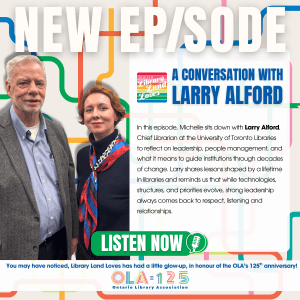
OLA Executive Director, Michelle Arbuckle sat down in February with Larry Alford—long-time University Chief Librarian for University of Toronto Libraries—to discuss his career and what he’s learned for the Library Land Loves podcast. From their conversation came an insightful moment about conflict intelligence, excerpted here.
To listen to the entire interview, visit the Library Land Loves podcast.
This excerpt has been edited for length and clarity.
Michelle: A couple of months ago, we were going to do a podcast on conflict intelligence and how to mediate disputes on staff, and I was looking around trying to find someone to interview, and Su Cleyle said, you’ve got to talk to Larry – Larry’s the one, he’s the master of this skill set. So what do you think about that?
Larry: I think every situation is its own situation, and you actually have to evaluate what’s going on. Conflict is often over issues that are not obvious. I mean, there’s probably something at the surface, but there’s [also] something else going on. I think treating people with respect, as I said earlier, is incredibly important, and even more important when there’s that kind of conflict going on. Getting people to talk to each other, getting people to understand other people’s points of view, is often a part of it as well. But also being willing [to], and eventually saying hard things. I mean, I think you also have to do that, and try to say it in ways that are respectful, but that people actually hear what you’re saying. I’m not sure I have a magic answer to that.
Michelle: Damn, I really wanted a magic answer
Larry: Sorry. It’s the hardest thing we do. I mean, it really is.
Michelle: When you know you have to have a difficult conversation with someone, how are you setting that stage?
Larry: Well, for myself, I think through the issues we need to talk about. Sometimes, if it’s going to be a really difficult conversation, I rehearse it myself, or sometimes I force my partner to listen—I don’t do that very often—just to make sure that it’s clear in my mind. What is the issue? How can we articulate what it is, again, in a respectful way? How can we, hopefully together, come to understand what the resolutions are?
Those are easy things to say. They’re really hard things to do.
Michelle: I’ll say, it is a skill set that I don’t think comes naturally to anyone, but what you’ve just outlined—the respect and the listening, and helping people understand that there are two sides of any issue, and we’ve got to come together—it’s important.
Larry: Early on in my career, when I was actually a department head 2 years out of high school, I worked very closely with this woman—she was on the staff, and she had some very serious personal problems. And I understood them, and they were of her [own] creation. I mean, they were serious problems, but she also was only working, like 60% of the time, which was a financial issue for her, but it was a serious issue for the other staff.
I sat down [with her], and we had some hard conversations; what could she do, what could we do. We needed a full-time employee. She had problems. How are we going to resolve this?
One of the things that I still remember and still feel really good about 20-plus years later [is that as] I was leaving Carolina, she stopped me one day, and she said, “I don’t know if you remember those conversations, but [they] changed me.” And she went on to actually get promoted to the highest level non-librarian in the UNC Libraries and did great work. And basically, she credited those conversations with having sort of allowed her—enabled, I guess is a better word—to do that. And, you know, I’ve never forgotten that, actually.
So it was really difficult, because partly I felt really sorry for her, but I also had an obligation to the institution, and we had to figure out something to do for her. It made a huge difference, I think, in how we did it.
Michelle: How do you draw the line, then? Because I’m finding especially with the younger workers coming in, that sometimes they’re expecting their managers to be somewhat of a therapist, to know what’s happening in their personal lives, and to help them manage not just what’s happening at their desks, but what’s happening outside of the office. Do you feel that pressure?
Larry: That’s interesting. I’m not sure I have felt that pressure recently, not in this job, but certainly over my career, I have. And I think that’s very difficult.
A woman that I worked with in Carolina, she was a wonderful librarian, and she was actually a town councilwoman in Carrboro, which is a sister city to Chapel Hill. We had a very difficult problem that we were both involved in, and she said to me, “You know, you have to learn [that] you can never practice private charity with public money. You have to draw a line.” And so I’ve also kept that in mind. I mean, I think you have to do both. You have to respect people, you have to try to help them be successful, but there is also a line. And you have an obligation, to be accountable to an institution, to the students here—and their parents—who basically are paying all of our salaries. I’m fond of saying 80% of our paychecks every month come from students or their parents. Only 20% of the U of T revenues come [from somewhere] other than student tuition and related fees, so I think you have to keep both of those things in mind, and be accountable to the people, but also to the institution and the people you’re serving.
That’s tough. Again, those are easy things to say. They’re hard things to actually do.

Related Posts